Bomb-Bedard-ed! What do you get for chasing? Eric-ed.

Eric Bedard Fishing

Anyone who plays roto knows that what you pay for your players can be just as important as who was on your team. The fantasy game is one of markets, and the winner’s objective is always to get as many players as possible that the market undervalued. How do you know a player was undervalued? At the end of the season he’s earned more than you paid for him.

The funny thing is that despite the importance of what guys cost, once Jerry Heath sold his legendary stat service back in the mid-90s, nobody kept track of what players actually cost each year. Nobody, that is, until I started collecting and publishing that info in the Fantasy Baseball Guide (ON SALE NOW) six or seven years ago.

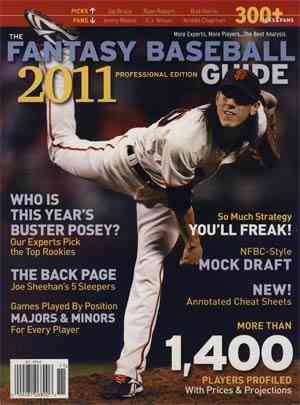
The Fantasy Baseball Guide 2011

Right now I’m putting the polish on the stats and projections that are going into the Patton $ Online product we sell (free trial going on now at software.askrotoman.com) and I came across the Cost and Price Scans for Eric Bedard, and do they tell a story:

In 2006, we paid $8 for Bedard, and he went out and earned us $17.

So, in 2007, we paid $19 for Bedard, and he went out and earned us $29.

So, in 2008, we paid $30 for Bedard, and he fell off the edge, earning $7.

But in 2009, we paid $19 because he was Eric Bedard, and he bounced back to earn $12 and lose us money.

Last year, we paid $8 for Bedard, and he didn’t pitch. What are we going to pay him this year?

Alex Patton says $5 right now. Mike Fenger says $4. I say he looks like a reserve to me, a guy who is worth controlling, but not such a good bet to spend money on, though if he’s having a good spring I’d pay a few dollars for his talented arm. The problem is that if he’s having a good spring his price is going to go back up to $8 or even more come opening day.

The point is that we tend to pay the most talented players as if they’re going to have as good a season as we can imagine, even if they’ve let us down recently. Bedard’s price went up lockstep with his earnings in 2007 and 2008, but when the injuries grabbed hold of him the air didn’t rush out of expectations. We kept bidding him up, hoping he’d get healthy again and the little discount we thought we were getting for his iffy health would become a big one.

The problem with this is that we’re actually still investing top dollar in a fragile economy. Over the past five years we’ve spent $81 on Bedard and he’s earned back $65. That’s not a disaster, but it isn’t a winning strategy either. You want to pay up for the guys who are going up before they go up, like Bedard in 2006 and 2007, and try to avoid the guys who are at their peak with nowhere to go but down, as the oft-injured Bedard has proved the last three years.

It isn’t always easy and it’s a call all of us get wrong more than we’d like, but it is the single most important mental adjustment you can make. Paying for last year’s stats, especially from players without a serious track record of success and health, is often a losing game.

Rob Neyer leaves ESPN

I started working for ESPN in 1995, when the newly launched ESPN Sportszone paid me for the baseball projections I’d put together for the book, “How to Win at Rotisserie Baseball.” The book wasn’t published that year because the publisher worried that the lockout, which killed the 1994 World Series, would kill the 1995 season. The ESPN Sportszone launched in April, shortly after the players and owners settled, and my projections became the first fantasy content on the fledgling website.

In 1996, ESPN paid me to go to Spring Training and report from the camps of Florida from a fantasy perspective, and somewhere in there Ask Rotoman was born. At some point that year, Rob Neyer became my editor. As he says in the fairwell note he posted on his blog at ESPN this week, he was an improbable fantasy baseball editor, and my recollection is that he pretty much left me alone. Now he’s moved on from ESPN, and good luck to him at what I hope proves to be a lively and successful tenure at SB Nation.

His first week there as National Baseball Editor has been energetic and promising. Rob is one of the most original and vibrant of modern baseball writers of the Internet era ( though not necessarily on the Internet). He’ll have a broader canvas to work on at SB Nation, and a chance to wrest some of the power away from the corporate giants. Go get ’em, Rob, for all of us.

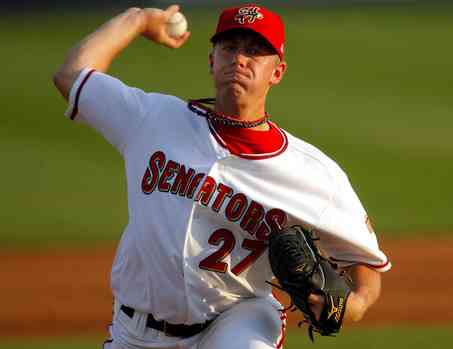
CHOOSE: Jordan Zimmerman, Travis Wood, Derek Holland

Jordan Zimmerman

A reader from Colorado wants to know who to favor.

I think it’s fair to say that Zimmerman and Wood are both faves this year among the fantasy cognoscenti. Holland has good stuff but his career has thus far been defined by his failures. Seems to me he’s a good bet to change that this year, too. How do I rank these guys?

Zimmerman was once a phenom and is now a Tommy John surgery survivor. He looked good in limited action after he returned last August. He’s healthy, he seems to know how to pitch, the real question is whether he will stay healthy, and what growing pains he will be subject to his second time through (as they say).

Wood was as successful in the majors last year as he’d been in Triple-A before being called up. He was a second round pick in 2005, not as much a phenom as Zimmerman, but he’s pitched well at every level. One knock is his size. At 5’11 and 170 pounds he’s not your classic scout’s choice. His GB/FB ratio last year was .66, not a nice number for a lefty in a right-handed hitter’s homer ballpark.

Holland’s got more major league experience than Zimmerman or Wood, combined, and has experienced more failure, too. He allowed 26 homers in 135 innings in 2009, his ML debut with Texas. A variety of injuries early last year limited his opportunities, but he allowed less than one homer per nine innings pitched overall, a very helpful sign while pitching in Texas. In his starts last year, however, he allowed six homers in 46.2 innings, and in his career has pitched better in relief than as a starter. I’m not sure that means anything for a guy entering his 25th year, but I’m certainly not saying it doesn’t.

FWIW, last year Zimmerman earned -$3, Wood earned $9, and Holland earned -$1. Those are single-league prices, of course. In the Guide this year I have them priced at $10, $12, and $3 respectively, and for now I’m going to stick with that. I’ll pay that but not more.

Young, talented but untested starters like these are a good place to find breakouts, and there is great excitement in signing this year’s hot young starter, but they also offer wise guys a place to invest a lot of money and lose all of it in a hurry. I think Zimmerman and Wood are going to go in the teens in NL leagues, and Holland could reach double digits with a good spring. That’s fine by me, someone else can take the risk. Much as I like Zimmerman and Wood this year, and I do a lot, it’s a mistake to push their prices up.

The sweet spot in young talented pitchers is volume. Get as many as you can as cheaply as you can and see what sticks. (The funny thing is that in mixed leagues these guys are all marginal, so you might be able to sign them for a buck or two or three. Late in the game, that’s a good signing with upside when you know there will be boring but somewhat reliable veterans to pluck off the waiver wire if you guess wrong.)

Dreaming of J.P. Arencibia

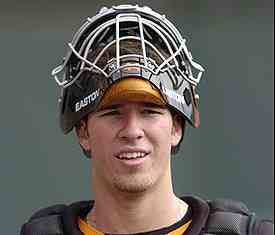
JP Arencibia

The Blue Jays flipped Mike Napoli (for Frank Francisco and a million bucks), have they really given the everyday catching job to JP Arencibia?

Since the immediate alternative is the least best Molina in baseball (that would be Jose), the answer appears to be yes.

Is that a wise move?

When we were putting the Guide together last November, my assumption was that Arencibia would win the starting job. He was coming off a year in which he hit 32 minor league homers (albeit in Las Vegas in the PCL), and drew a decent number of walks compared to past performance Still, I gave him a price of $3 because there were some big questions.

For one, the MLE of his .301 BA in the PCL last year is .231, with an OPS of .716 (according to the Baseball Forecaster). This isn’t a projection, but a translation of last year’s numbers to a major league context.

Plus, despite reported improvement last year as a backstop, defense hasn’t been the strong part of his game. Presumably, the Jays are looking at 2011 as the year Arencibia learns to work a major league game, deals with major league pitchers, and gets settled in. This is a time, I would expect, when he’s going to be told to focus on his defense, and do his best with the bat. Whatever that may be. If it’s not much, no one is going to be concerned because he’s concentrating on catching. Well, you’re going to be concerned if you’ve paid real scratch to get him on your roster.

He’s got real power and I’m certainly not swearing that he’s going to fail, but there’s a real chance that he’ll get off to a bad start (I mean a bone-clanking big-whiffing disaster of a start to the season) and the club will be forced to demote him. So I’m saying, bid lightly. If you can grab him for $3, or if you have to reach to $5 for him, it may well work out, but if you bid assuming he’s good for 20 homers and a batting average that won’t destroy you, there’s a good chance you will be destroyed.

DIL: The Voros McCracken Story

Based on this story by Yahoo’s fine Jeff Passan, Voros McCracken leads a Defense Independent Life.

Like much writing on the internet, this story is probably twice as long as it should be, and because of repetition suffers from a sentimentality that makes me less sympathetic than I might be. But it is a good and sad story, and helps explain that whole Voros thing that always gets folks worked up, and puts a human face on it, too.

I do think that it isn’t reasonable to expect to make a living from thinking about baseball, or, for instance, inventing a game like Rotisserie. It could happen, but more than likely won’t. Them’s the breaks.

UPDATE: A story in Slate today looks at efforts to discover Moneyball-like efficiencies in soccer stats. Curiously, these efforts are led by Billy Beane, and the story ends noting that Voros is working on soccer these days. But the real insight is that while efforts to decode baseball are largely open source, the push into soccer (which has no meaningful collective “sabermetrics”) are being led by proprietary interests, just as Voros’ revolutionary insight was made in public, and his work life these days for a European soccer club is private.

The Mike Napoli Problem

My take on The Worst Trade in the World Ever was that clearly the Angels’ motivation was to get rid of Mike Napoli, who everyone acknowledges is a bad catcher and a somewhat limited hitter against right-handed pitchers. These are not insignificant problems for a player who, though he hits well for a catcher, is not nearly so good for a first baseman or DH.

The Angels also as well as upgrade the aging and unreliable Juan Rivera in the outfield.

This isn’t to excuse the Angels’ side of this. It’s near impossible to imagine that if they had insisted that the Blue Jays throw in, say, $10M (or heck, $25M) along with Vernon Wells for Napoli and Juan Rivera, that the Jays wouldn’t have gone for it. But I think it’s worth noting that Napoli was unlikely to be a positve force this year on the Angels because Mike Scioscia wasn’t going to let him catch, he wasn’t going to displace Kendry Morales at first base, and the Angels needed room for Bobby Abreu and Torii Hunter to DH a fair amount.

The Jays’ subsequent dumping of Napoli on the Rangers is further evidence of that. Johan Keri tries to argue that this is a good trade for both sides, but his reasoning is a little mushy, even if you follow his own argument. It’s really more like a shuffling of resources and money, to which both teams find some appeal.

Napoli’s role on the Rangers, apart from injury, appears to be about 200 AB vs. left-handers while platooning at first base with Mitch Moreland, and an occasional turns behind the plate and at DH. The Rangers signed a catching regular (Yorvit Torrealba) in the offseason, and according to Keri the Rangers’ braintrust likes good defensive catchers (like backup Matt Treanor). With DH filled by Michael Young, there aren’t that many additional at bats to be had for Napoli with the Rangers unless Moreland fails or there is an injury.

But there may well be more than he would have had with the Jays. Not only is Toronto committed to JP Arencibia this year at catcher, but they have Edwin Encarnacion and Adam Lind at 1B and DH. The marginal advantage of Napoli over any of them, especially given his defensive limitations at catcher, was small, and now he’s gone.

The point here isn’t that Napoli is a waste, but rather that despite his admirable and somewhat overlooked offensive skills, as a complete player he clearly isn’t a valued commodity. His poor defense reduces his marginal value substantially at catcher, and he doesn’t hit enough to be a regular first baseman. With a price of somewhere around $5-$6M this year he’s an expensive platoonist versus lefties. It seems the Rangers recognize that and are willing to pay.

So were the Angels, in their own way.

I love this line…

“Spring training battles won’t solve anything; they’ll just raise draft prices.” Nick Minnix

Identifying (or lucking into) the cheap closers is a major key to winning fantasy leagues, which is why I continually advocate going cheap and counter intuitive. If it doesn’t work out, you have to dig out of a hole for sure, but if you score the free 35 saves guy, you likely got crowned king.

FYI: Many fantasy winners think locking up saves is a good way to win. And they’re right, so long as your hitters come through. That happens sometimes.

I don’t think we know enough about what actually works to make small distinctions. It makes sense to me to bet on known quantities and let the chips fall where they may with what we don’t know.

Look at this

The Guide has Arrived!

The Fantasy Baseball Guide 2011

I just received copies from the printer, and copies should start arriving in northern Ontario any day now, and elsewhere soon thereafter.

I’m told that we’ll be back in Wal Mart this year (a snafu last year kept us out) and Barnes and Noble and Borders, as usual. Please let us know where you find it, and where you don’t.

This year’s edition has a new format for the Mock Draft devised by designer Brian Meissner, which is so smart and useful I’m speechless, and what I hope are more fun and informative cheat sheets, plus tons of Picks and Pans and, on the back page, Joe Sheehan’s five sleepers.